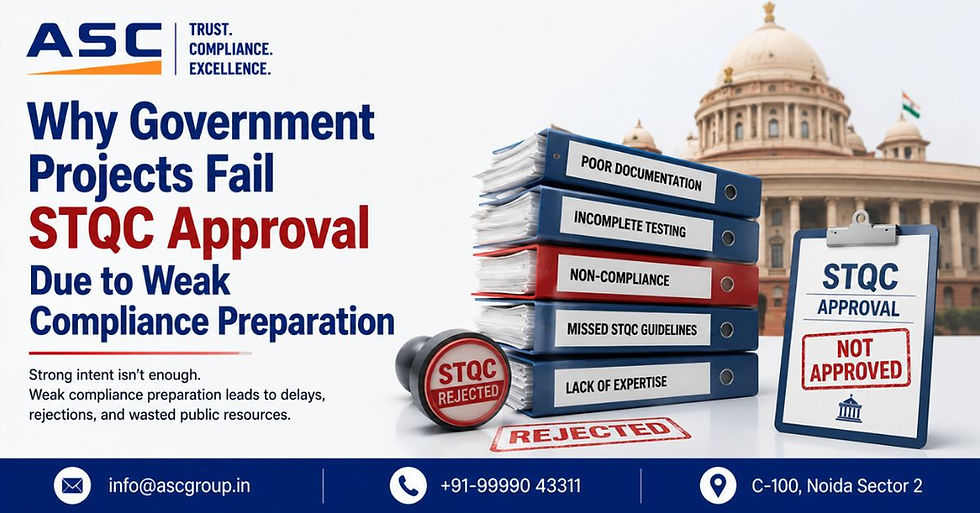
Why Government Projects Fail STQC Approval Due to Weak Compliance Preparation
- ASC Group
- May 19
- 3 min read

Government and public-sector digital projects in India are expanding rapidly, but many still fail during quality and security audits. One of the most common reasons is weak preparation for STQC Certification, STQC Certification Consultants support, and structured compliance readiness. Without proper alignment to standards, even well-funded projects get delayed or rejected during evaluation.
The STQC Certification process ensures that IT systems, software applications, and e-Governance platforms meet strict quality, security, and performance benchmarks defined by the government. However, many projects underestimate its complexity and fail to prepare adequately.
Why STQC Certification Matters for Government Projects
The Standardisation Testing and Quality Certification Directorate (STQC) is responsible for ensuring quality assurance and security compliance for IT systems used in government services.
STQC Certification is essential for:
E-Governance portals
Public service applications
Data management systems
Digital identity platforms
Critical infrastructure software
Without a valid stqc certificate, government projects cannot be fully deployed or scaled.
The Core Problem: Why Government Projects Fail STQC Approval
Many projects fail not because of poor technology, but due to weak compliance preparation.
1. Lack of Early Compliance Planning
Most teams focus on development first and think about certification later. This leads to major rework.
2. Poor Documentation Quality
Incomplete technical documentation is one of the most common reasons for rejection during STQC Certification Services review.
3. Ignoring Security Requirements
Many systems fail security audits due to missing encryption standards, weak access controls, or improper data handling.
4. No Understanding of STQC Framework
Teams often lack clarity on STQC testing parameters and evaluation methodology.
5. Delayed Testing Preparation
Applications are submitted without readiness for performance and vulnerability testing.
These issues significantly increase the stqc certification cost due to repeated audits and re-submissions.
What is Included in STQC Certification Process?
The STQC Certification process involves multiple technical and compliance stages:
Requirement analysis
Software quality testing
Security assessment
Performance evaluation
Documentation review
Final certification audit
Each stage requires precise preparation and expert-level understanding of compliance standards.
Common Challenges in STQC Certification Services
Organizations seeking stqc certification services often face:
Repeated audit failures
Delays in approval cycles
High compliance correction costs
Misinterpretation of security guidelines
Gaps between development and audit expectations
These challenges are more common in large-scale government projects where multiple stakeholders are involved.
How STQC Certification Consultants Help Reduce Failures
Professional STQC Certification Consultants play a crucial role in improving approval success rates. They ensure that projects are audit-ready from the beginning.
Key Support Provided by Consultants
Compliance gap analysis before submission
Documentation structuring as per STQC norms
Security and performance readiness checks
Mock audits and pre-assessment testing
Coordination with STQC authorities
Guidance on reducing rework cycles
With expert involvement, projects significantly reduce the risk of rejection.
Question: Why Do Well-Funded Government Projects Still Fail STQC Approval?
Even with strong budgets and advanced technology, many projects fail due to one core issue: lack of compliance integration during development.
Solution
The solution is early-stage involvement of STQC Certification Consultants who:
Integrate compliance into system design
Identify gaps before submission
Reduce dependency on rework cycles
Align development with STQC standards
Improve audit readiness from day one
This approach ensures smoother certification and faster deployment.
Understanding STQC Certification Cost Factors
The stqc certification cost is not fixed and depends on several variables:
Complexity of the software system
Number of modules and integrations
Security testing requirements
Number of audit cycles required
Documentation readiness
Re-testing and correction efforts
Projects that fail initial audits often end up paying significantly higher costs due to repeated compliance efforts.
Why Early Preparation is Critical for STQC Certification
Early compliance planning reduces:
Project delays
Audit failures
Budget overruns
Security vulnerabilities
Deployment risks
Government agencies that integrate STQC Certification Services early in the project lifecycle experience smoother approvals and faster rollout.
Best Practices to Ensure STQC Approval Success
To improve success rates, organizations should:
Include compliance experts in the planning phase
Follow STQC guidelines from project initiation
Conduct internal security audits regularly
Maintain proper technical documentation
Perform pre-certification testing
These practices help ensure readiness for final evaluation.
Role of STQC Certification in Digital India Growth
As India continues to expand its digital infrastructure, STQC Certification has become a critical quality benchmark. It ensures:
Secure digital platforms
Reliable public service systems
Standardized software performance
Trust in government applications
Without proper compliance, large-scale digital transformation projects face higher failure risks.
Final Thoughts
Government projects often fail STQC approval not because of technical weakness, but due to insufficient compliance preparation. A structured approach to STQC Certification, supported by experienced STQC Certification Consultants, can significantly improve approval success rates.
By focusing on early-stage compliance, proper documentation, and security readiness, organizations can reduce risks, control stqc certification cost, and ensure smooth deployment using professional stqc certification services.
In today’s digital governance ecosystem, STQC readiness is not optional—it is a critical success factor for every government IT project.
Comments