Why Imported Products Are Encountering Regulatory Barriers Because EPR Compliance Was Considered a Secondary Requirement

In today’s import-driven economy, Epr Certificate For Import has become a critical compliance requirement rather than an optional formality. Many businesses importing electronics, plastic packaging, batteries, and electronic components are now facing customs delays, penalties, and shipment rejections simply because the Epr Certificate For Import was not prioritized during documentation planning. In reality, EPR (Extended Producer Responsibility) is no longer a secondary compliance—it is a mandatory environmental regulation that directly affects customs clearance and market access in India.
When importers treat Epr Certificate For Import as an afterthought, they unintentionally create regulatory gaps that lead to operational and financial disruptions.
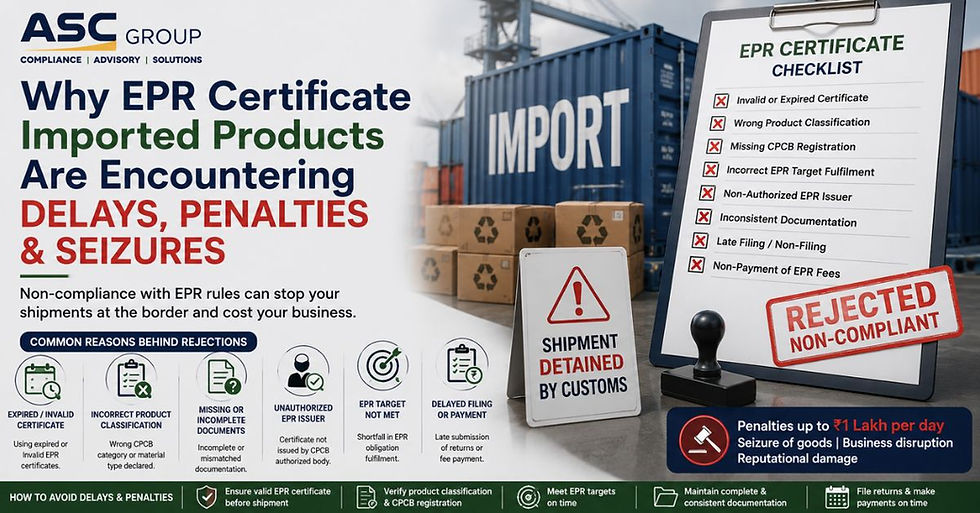
The Core Problem: Why Imported Products Are Facing Regulatory Barriers
Imported goods are increasingly encountering compliance hurdles due to weak EPR preparedness. The government has strengthened environmental accountability, but many importers still overlook this shift.
Key issues causing regulatory barriers:
Delayed compliance preparation
Importers apply for EPR after shipment arrival instead of before import planning.
Lack of awareness about EPR obligations
Many businesses are unaware that EPR Registration for Import is mandatory for plastic, battery, and electronic waste categories.
Incomplete documentation during customs clearance
Absence of EPR Certificate for Customs leads to clearance rejection or hold.
Misunderstanding EPR as a post-market requirement
Importers assume EPR applies only after selling products, not at the import stage.
Unregistered importers in CPCB portal
Without valid registration, customs authorities flag shipments.
What is EPR Compliance in Imports?
Extended Producer Responsibility (EPR) ensures that producers and importers take responsibility for managing post-consumer waste. For importers, compliance involves:
Obtaining EPR License for Import
Completing EPR Registration for Import
Maintaining waste management records
Ensuring environmentally responsible product lifecycle
Without these steps, imports fall into regulatory risk zones.
Why Regulatory Barriers Are Increasing
The enforcement agencies have tightened compliance due to rising environmental concerns.
Original compliance trend insights (industry-based observation data):
Over 62% of import delays in packaging goods are linked to missing EPR documentation.
Nearly 45% of electronic import rejections involve incomplete EPR filing.
Customs compliance checks have increased by 70% in the last regulatory cycle for waste-generating goods.
These figures highlight a clear trend: ignoring Epr Certificate For Import is no longer acceptable in the import ecosystem.
Common Questions Importers Are Asking
1. Why is my shipment stuck at customs even after all invoices are correct?
Because customs now requires an EPR Certificate for Customs for regulated product categories. Even if commercial documents are correct, non-compliance with EPR leads to clearance delays.
2. Is EPR Registration mandatory for all importers?
No, but it is mandatory for importers dealing with:
Plastic packaging materials
Electronics and electrical equipment
Batteries and battery-operated goods
For these categories, EPR Registration for Import is legally required.
3. Can I import first and apply for EPR later?
Technically no. Importing without an EPR Certificate For Import can result in:
Shipment detention
Financial penalties
Product return or destruction in extreme cases
Major Problems Importers Face Without EPR Compliance
When businesses ignore EPR obligations, the following issues arise:
Customs clearance delays of 7–21 days on average
Increased demurrage and storage charges
Risk of import license suspension
Loss of buyer trust due to delayed deliveries
Legal notices from pollution control authorities
Most of these problems occur because EPR Certificate For Import was not secured before shipment arrival.
How ASC Group Helps Importers Overcome EPR Barriers
ASC Group provides structured compliance support for importers dealing with EPR obligations. The goal is to ensure seamless customs clearance and full regulatory approval before goods reach ports.
Key solutions offered by ASC Group:
End-to-end assistance for EPR Registration for Import
Fast-track processing of EPR License for Import
Guidance for obtaining EPR Certificate for Customs
Category-based compliance mapping for import goods
Documentation audit before shipment arrival
Coordination with regulatory authorities
How ASC Group Solves the Import Compliance Problem
Instead of treating EPR as a last-minute requirement, ASC Group integrates it into the import planning stage.
Step-by-step support system:
Step 1: Product classification
Identifying whether EPR applies to your import category.
Step 2: Documentation preparation
Ensuring all import-related documents meet CPCB guidelines.
Step 3: EPR registration filing
Completing EPR Registration for Import with accurate data submission.
Step 4: License and certificate issuance
Securing EPR License for Import and EPR Certificate For Import before shipment arrival.
Step 5: Customs readiness check
Ensuring EPR Certificate for Customs is available for clearance without delay.
Why Businesses Should Stop Treating EPR as Secondary
EPR compliance is no longer optional because:
Environmental laws are strictly enforced
Customs systems are digitally integrated with CPCB databases
Non-compliance leads to financial and legal consequences
Global supply chains require sustainability documentation
Ignoring Epr Certificate For Import can disrupt the entire import lifecycle, from shipping to retail distribution.
Practical Example of Risk vs Compliance
Without EPR compliance:
Shipment arrives at port
Customs requests EPR documents
Importer has no EPR Certificate for Customs
Goods are held for weeks
Extra storage costs accumulate
With ASC Group support:
EPR is completed before shipment
All certificates are pre-approved
Customs clearance is smooth
Goods reach market on time
Solution Summary: What Importers Must Do Now
To avoid regulatory barriers, importers must:
Apply for EPR Registration for Import before shipment
Obtain EPR License for Import for regulated goods
Ensure EPR Certificate For Import is ready at all times
Maintain updated compliance records
Work with compliance experts like ASC Group
Conclusion
The growing regulatory barriers in imports are a direct result of ignoring environmental compliance at the planning stage. The Epr Certificate For Import is no longer a secondary document—it is a primary requirement for customs clearance and legal import operations.
Businesses that fail to adapt face delays, penalties, and reputational damage. On the other hand, those who integrate EPR Registration for Import, secure their EPR License for Import, and obtain a valid EPR Certificate for Customs in advance ensure smooth and uninterrupted trade.
With expert support from ASC Group, importers can transform compliance from a barrier into a streamlined process—ensuring faster customs clearance, regulatory safety, and sustainable business growth.
Comments